Vela
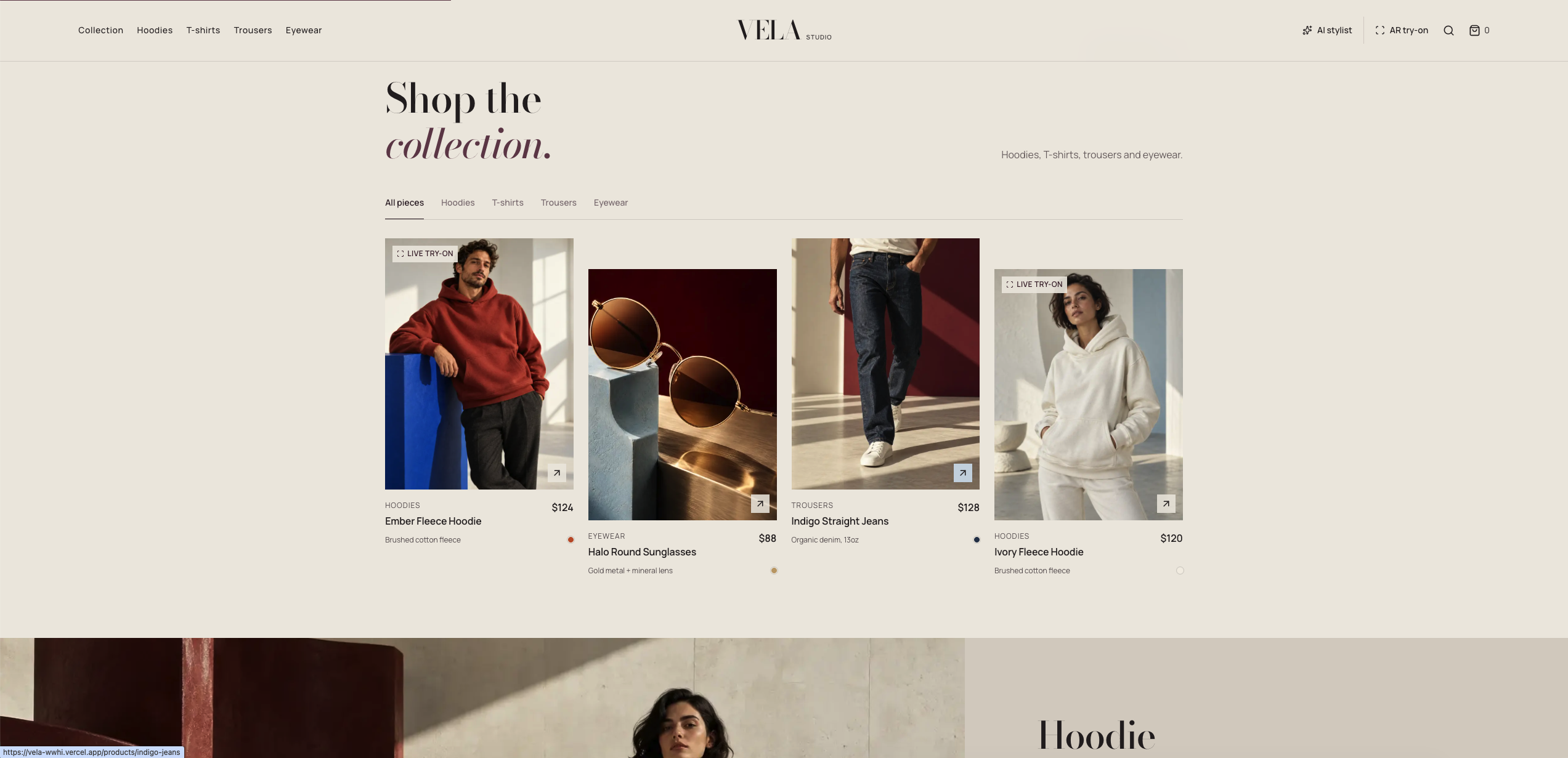
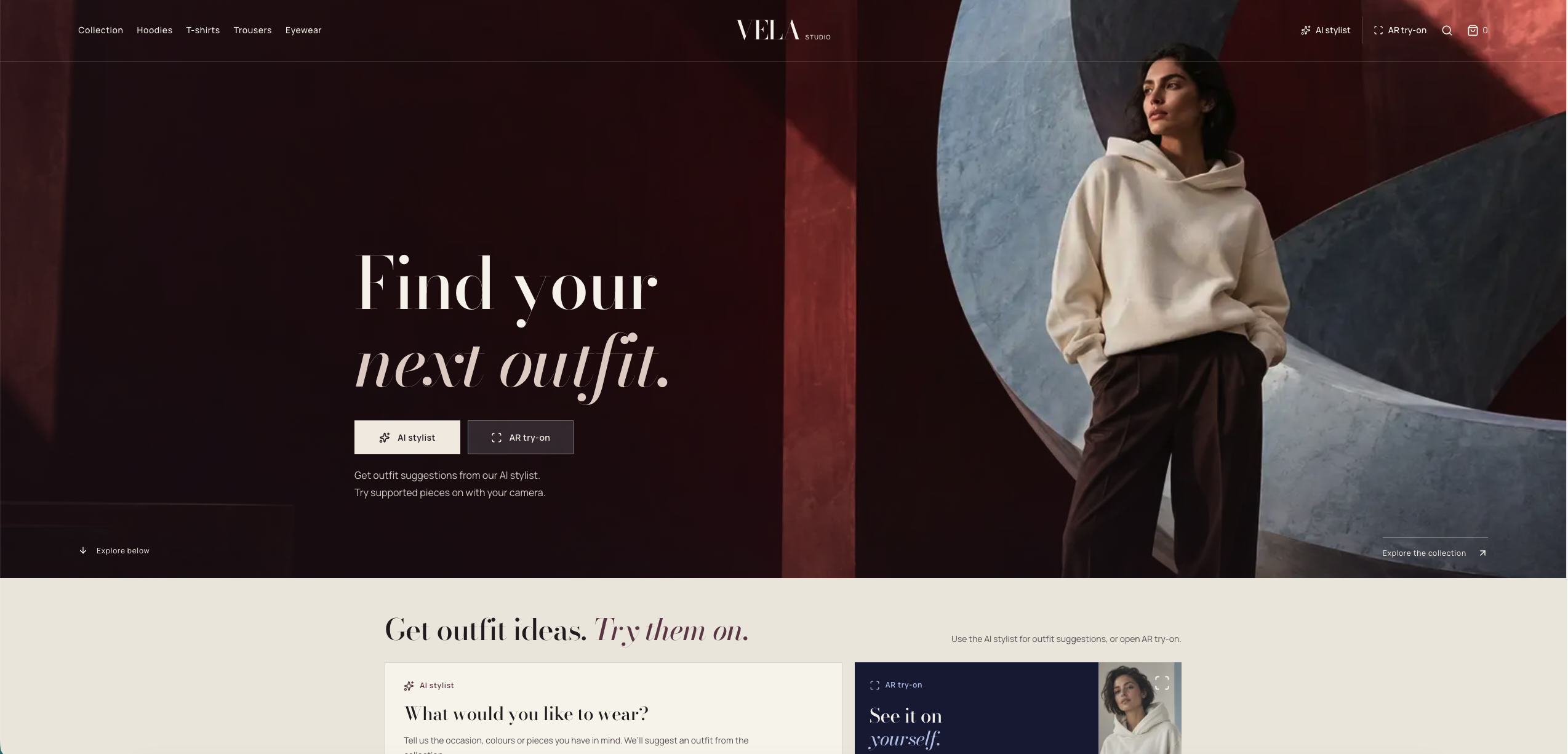
Vela reimagines online fashion shopping. See how each piece looks on you in a live camera fitting room, then let our AI stylist suggest the pieces that complete your look.
 CSS
 Docker
 Git / GitHub
 Next.js
My role
Solo full-stack developer. I designed and built the product end to end: Next.js storefront and admin, Prisma / PostgreSQL catalog and orders, Snap Camera Kit try-on, Serwist PWA, OpenAI-backed recommendations with a catalog fallback, Docker local Postgres, and production deploy on Vercel + Neon.
Tech stack
- Next.js
- React
- TypeScript
- Tailwind CSS
- Prisma
- PostgreSQL
- Neon
- Docker
- Snap Camera Kit
- Serwist (PWA)
- OpenAI (optional)
- Vercel
- Git / GitHub
Next.js 15 (App Router) serves the storefront, admin, and /api. Prisma talks to PostgreSQL. Locally, Docker Compose runs Postgres; production uses Vercel + Neon (pooled DATABASE_URL + direct DIRECT_URL). Live try-on runs in the browser through Snap Camera Kit lenses.
Features
- Live AR fitting room — open the camera and see marked pieces on you
- Cart, product pages, and AI “Ask the stylist” / bag completions
- Catalog of hoodies, tees, trousers, and eyewear with studio packshots
- Category pages, filters, sort, search, and lookbook browsing
- Cash on delivery and bank transfer checkout (no card processor)
- Installable PWA with offline fallback, install prompt, and mobile tab bar
- Admin for products, orders, and try-on lens IDs
- Responsive storefront across phone, tablet, and desktop
Architecture
Shopping & try-on workflow
- Shopper browses the catalog, lookbook, or category mosaics.
- Pieces marked for try-on open /try-on with Snap Camera Kit and the product lens.
- They add to bag, choose size/color, and check out with COD or bank transfer.
- A server action writes the order to Postgres; admin reviews it in
/admin. - Optional OpenAI powers stylist asks and recommendations; without a key, catalog rules still return picks.
Challenges & solutions
AR try-on that matches the catalog
Challenge: Lifestyle photos and side-angle shots do not map cleanly to Camera Kit lenses; the store looked inconsistent and try-on felt disconnected from the grid.
Solution: Rebuilt the catalog around straight-on studio packshots (solid sand backdrop), six colourways per category, and per-product tryOnLensId fields so the fitting room and PDP share the same visual language.
Prisma on a pooled production database
Challenge: Schema pushes fail through Neon’s pooler, while Vercel serverless needs pooled connections at runtime.
Solution: DATABASE_URL uses the Neon pooled host (-pooler). DIRECT_URL uses the direct host for prisma db push / seed. The Vercel build runs prisma generate && prisma db push && next build.
Recommendations without locking the store to OpenAI
Challenge: Stylist and “complete the look” features should work even when no API key is set, or when the model fails.
Solution: /api/recommend tries OpenAI (gpt-4o-mini) first, then falls back to in-house catalog scoring so shop, PDP, and bag still get picks.
Installable app without a separate native codebase
Challenge: Phone shoppers expect an app-like shell; a second mobile project was out of scope.
Solution: Serwist service worker, web app manifest, offline page, install prompt (including iOS Add to Home Screen hints), and a bottom tab bar for Home / Shop / Try on / Bag.
Shop layout crushing the product grid on mobile
Challenge: Filters and the Featured sort sat in a horizontal flex with the grid, so product cards collapsed to a few pixels wide on phones.
Solution: Stack filters above the grid on small screens, wrap the sidebar in a single column, and replace the native <select> sort with a portaled dropdown so the menu opens under the control instead of over the category banner.
Landscape sections with portrait packshots
Challenge: Category tiles and fitting-room bands left empty side bands when a single 3:4 still was dropped into a wide frame.
Solution: Three-up category collages for landscape tiles, a cinematic fitting-booth stage for the try-on band, and constrained product galleries so PDPs are not flush-left full bleed.
A closer look.